


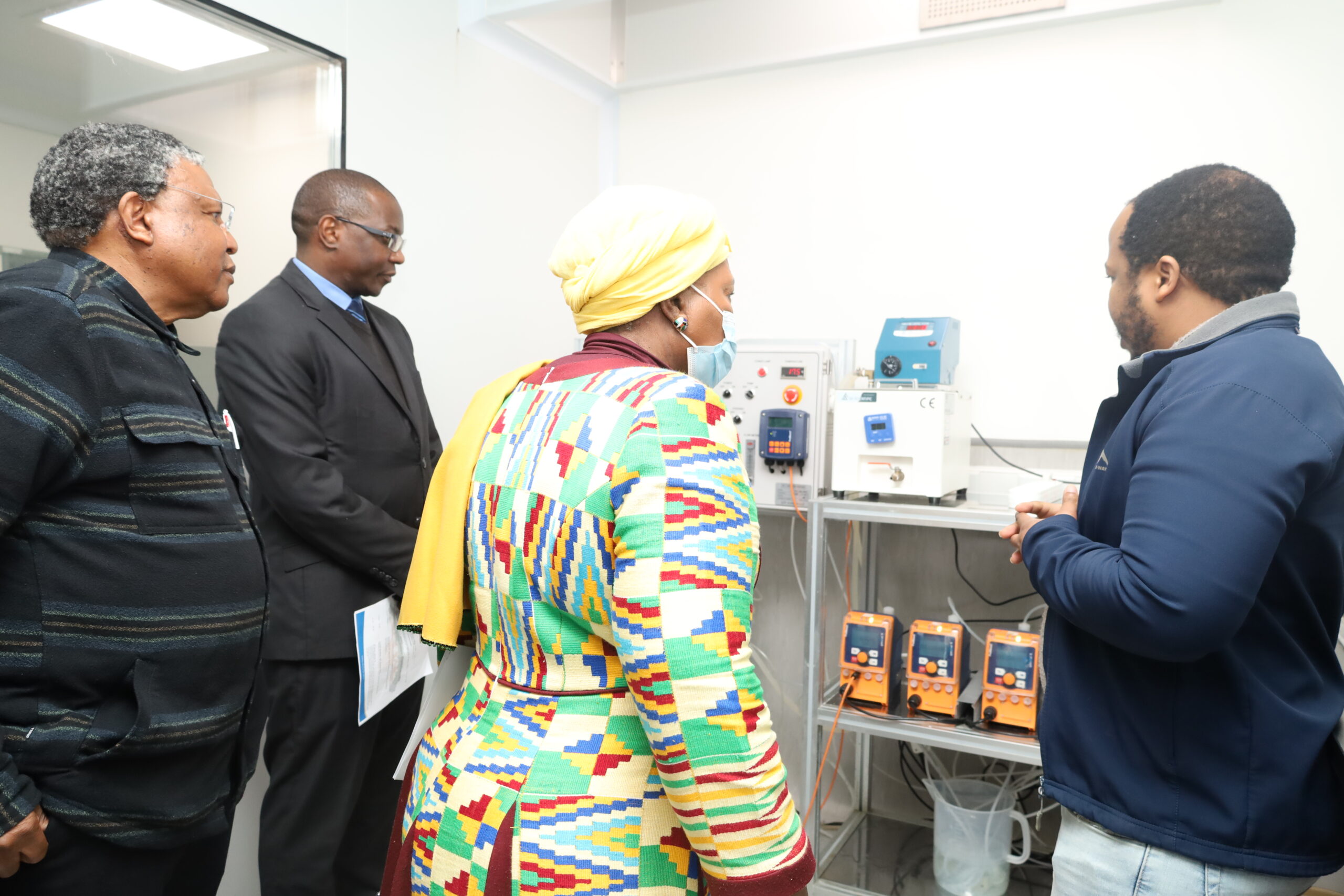
University of Limpopo Chancellor Dr Nkosazana Dlamini-Zuma (middle) is accompanied by Vice-Chancellor and Principal Dr Jeffrey Mabelebele, and Professor Phuti Ngoepe during a tour of the Material Modelling Centre, where she explored the cutting-edge infrastructure supporting battery materials research as part of her engagement with the University’s Research Chairs.
Photos: Frans Matlala
Dr Nkosazana Dlamini-Zuma encourages researchers to strengthen African partnerships and ensure their work addresses the continent’s most pressing challenges
By Reuben Maake – reuben.maake@ul.ac.za
The Chancellor of the University of Limpopo (UL), Dr Nkosazana Dlamini-Zuma, has challenged the University’s funded research chairs to strengthen their focus on African-centred scholarship
The Chancellor made the remarks during a visit to the university’s research facilities, where she engaged with research chairs to learn more about their work, ongoing projects and future plans.
Dr Dlamini-Zuma called for stronger collaborations across Africa to ensure research delivers practical solutions to the continent’s social, economic and environmental challenges.
Emphasising the university’s core mandate, she said the motto, Finding Solutions for Africa, should remain the guiding principle for all research undertaken at the institution.
“Our research must respond to the needs of the continent and contribute directly to improving the lives of African people,” she said.
The University currently hosts ten Research Chairs in fields including Agriculture, Computational Modelling, Information Systems, Mental Health, Prevention and Control of Non-Communicable Diseases, the Centre for Global Change, and Liberation, Heritage and Politics.
Professor Phatu Mashela, who leads the Centre for Excellence in Climate-Smart Agriculture, said the Centre hosts four research chairs: (a) Regenerative Agriculture, (b) Regenerative Agricultural Remedies, (c) Animal Production, and (d) Agricultural Economics, supported by the National Department of Agriculture and the Agricultural Research Council in partnership with UL. The regenerative agriculture research chairs are focusing on soil health and plant health, while the Animal Production and Agricultural Economics research chairs focus on animal health and impact assessment, respectively. Existing partnerships in Africa include CCARDESA (Centre for Coordination of Agricultural Research and Development for Southern Africa) and the Forum for Agricultural Research in Africa (FARA), whereas local partnerships include various universities, departments of agriculture and ZZ2.
Professor Kwabena Ayisi, Director of the Centre for Global Change, said the centre is using precision agriculture to help farmers adapt to climate change and changing weather patterns. He warned that future El Niño conditions could increase the risk of drought and place further pressure on South Africa’s water resources.
Professor Kgothatso Shai, Chair of Liberation, Heritage and Politics, said his research seeks to preserve Limpopo’s heritage while promoting a broader understanding of African history and identity. He added that the chair is committed to building partnerships, mentoring young researchers and contributing to public dialogue on contemporary social and political issues.
Professor Tebogo Mothiba, who leads the Prevention and Control of Non-Communicable Diseases Research Chair, while Professor Phuti Ngoepe showcased research on lithium battery materials, mineral extraction and the decarbonisation of transportation in Africa. He said the centre has established partnerships with institutions in China and is supported by a team of more than 50 researchers.
Commending the presentations, Dr Dlamini-Zuma encouraged the Research Chairs to strengthen international partnerships while maintaining a clear African focus.
“I’m impressed by what I have seen, particularly the work on battery materials and agriculture. The quality of research being conducted here is exceptional, and through stronger international collaboration we can remain at the forefront of innovation,” she said.
She concluded by expressing pride in the university’s progress. “I am proud of this university. It has moved beyond the label of a historically disadvantaged institution because of the outstanding work our researchers are doing, and I will proudly share these achievements wherever I go.”

University of Limpopo Chancellor Dr Nkosazana Dlamini-Zuma is joined by University management and Research Chair holders during an engagement that focused on advancing African-centred research and developing solutions to the continent’s challenges.
“The university’s motto, ‘Finding Solutions for Africa’, must be reflected in our research. Our work should make a meaningful difference to the continent.”