


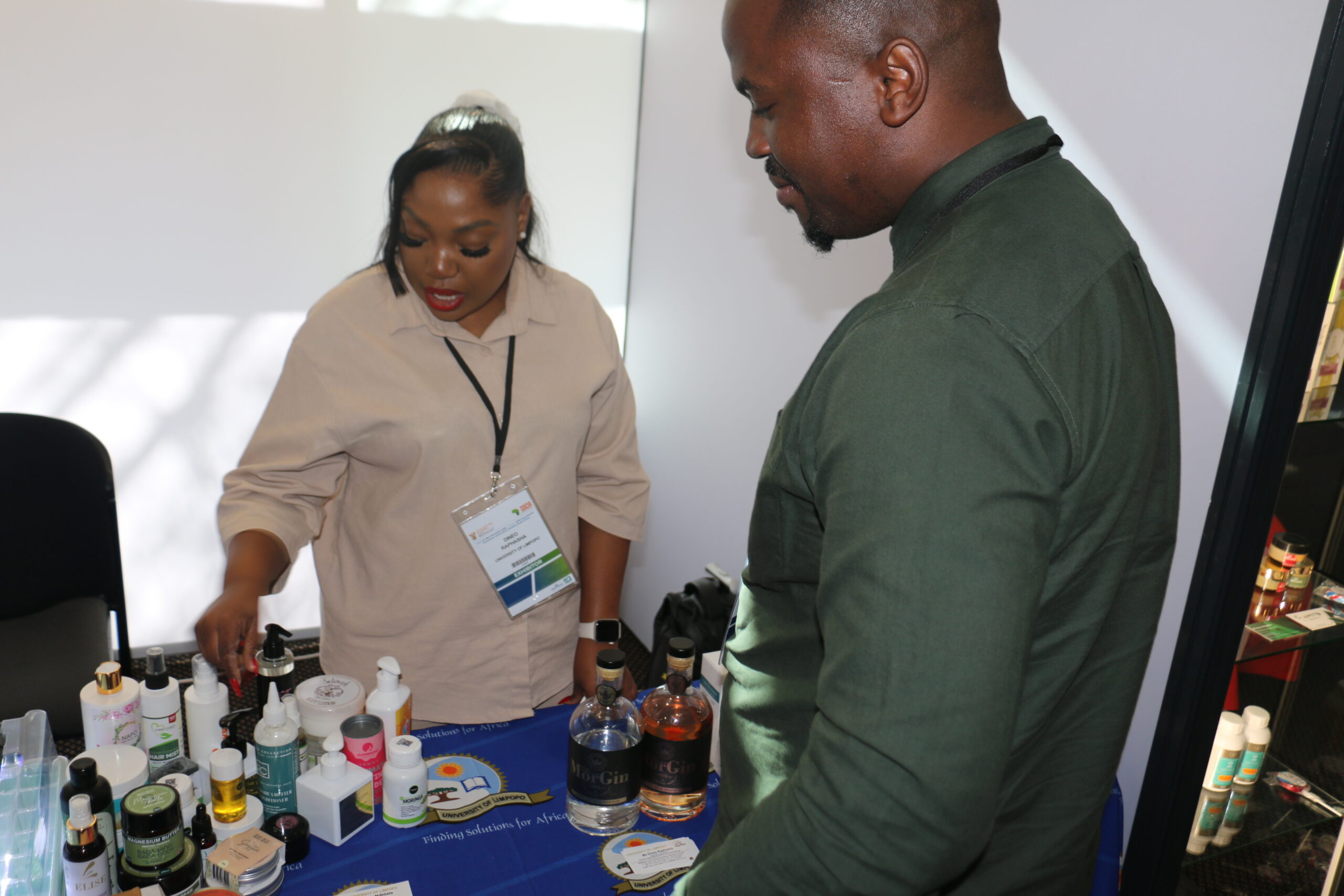
Dineo Raphasha, Laboratory Technician at the University of Limpopo (UL), and Vusi Makamu, UL International Relations Officer, showcase some of the products currently on the market that have been tested at UL to ensure quality and consumer safety. Photos: UL archives
By Abba Armooh – Abba.armooh@ul.ac.za
Networking with industry experts and sharing research expertise were top of the agenda when the University of Limpopo (UL) scientists participated in the Science Forum South Africa (SFSA), hosted by the Department of Science, Technology and Innovation (DSTI) at the CSIR International Convention Centre in Pretoria
With strong representation from the Faculty of Science and Agriculture (FSA), the Technology Transfer Office (TTO), and the International Affairs Office (IAO), UL showcased its commitment to being a research-intensive institution that shapes South Africa’s scientific and innovation agenda. The Forum served as a valuable platform for the University to build partnerships, showcase research capabilities, and engage with government, academia, and industry stakeholders on national science priorities.
Reflecting on the strategic value of UL’s participation, Dineo Raphasha, Laboratory Technician and PhD candidate in the FSA, highlighted the importance of such engagements.
“Events like the Science Forum allow us to stay informed about new innovations and policy developments while strengthening partnerships and showcasing our expertise. They improve our capacity, enhance our visibility, and position UL as an active player in the national innovation system,” she explained.
The forum further demonstrated how UL’s participation in national science platforms contributes to its mission of connecting research with societal needs. Deputy Minister for Public Service and Administration, Hon Pinky Kekana, commended universities for their continued role in advancing African-led research and innovation.
“Universities, including UL, must continue playing a central role in structuring, testing, and validating African solutions so they can be effectively and safely used by society,” she said.
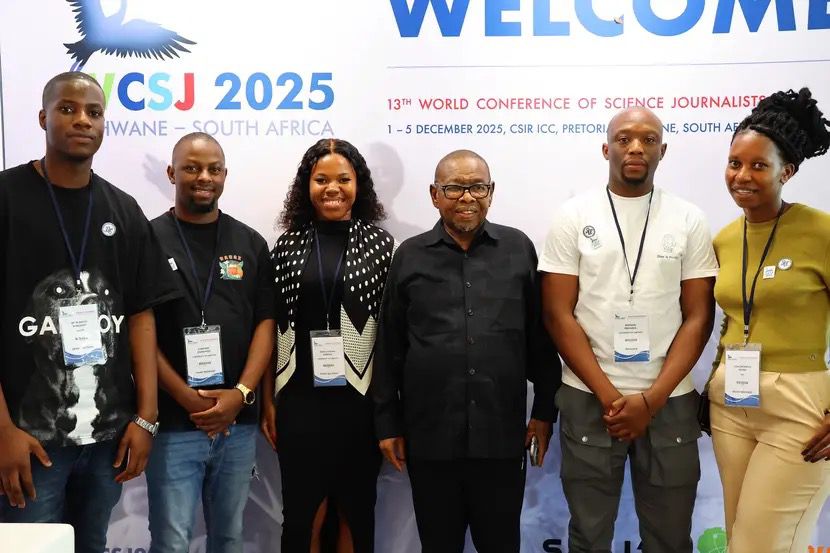
Minister of Science, Technology and Innovation, Prof Blade Nzimande (centre), pictured with members of the University of Limpopo (UL) delegation — Pilot Manganyi, Thipha Kganyago, Abba Armooh, Maphari Machaka, and Lehlogonolo Seema — during the 13th World Conference of Science Journalists (WCSJ) held in Pretoria.
Building on the momentum from the Science Forum, UL extended its influence to the global stage by participating in the World Conference of Science Journalists (WCSJ) 2025 — the first to be hosted on African soil. Supported through travel grants from the DSTI, UL proudly joined the South African delegation with six emerging science communicators selected from the three cohorts of the Postgraduate Diploma in Science Communication, a programme fully funded by DSTI since 2023. This milestone reaffirms UL’s commitment to strengthening science literacy and enhancing national science engagement capacity.
The WCSJ brought together global leaders in science communication to discuss key issues such as ethical reporting, public trust in science, and the importance of elevating African scientific narratives. Participation in the conference allowed UL’s researchers and communicators to gain valuable insights into global best practices while contributing South African perspectives to international discussions.
In his keynote address, Minister of Science, Technology and Innovation, Prof Blade Nzimande, emphasised that science journalism remains a national priority for advancing South Africa’s knowledge economy.
“Science journalism is an integral part of our Science Engagement Programme. We intend to build a society that is knowledgeable about science, is science literate, and is able to form independent opinions on science issues,” he said.
Among the grant recipients, Lehlogonolo Seema, a Research Administration Assistant in UL’s Department of Biodiversity, expressed gratitude for the opportunity to participate in the prestigious event.
“The conference has been incredibly informative. Learning from experienced science journalists from various countries and understanding their challenges has been eye-opening—especially observing how journalists are treated differently across nations,” she reflected.
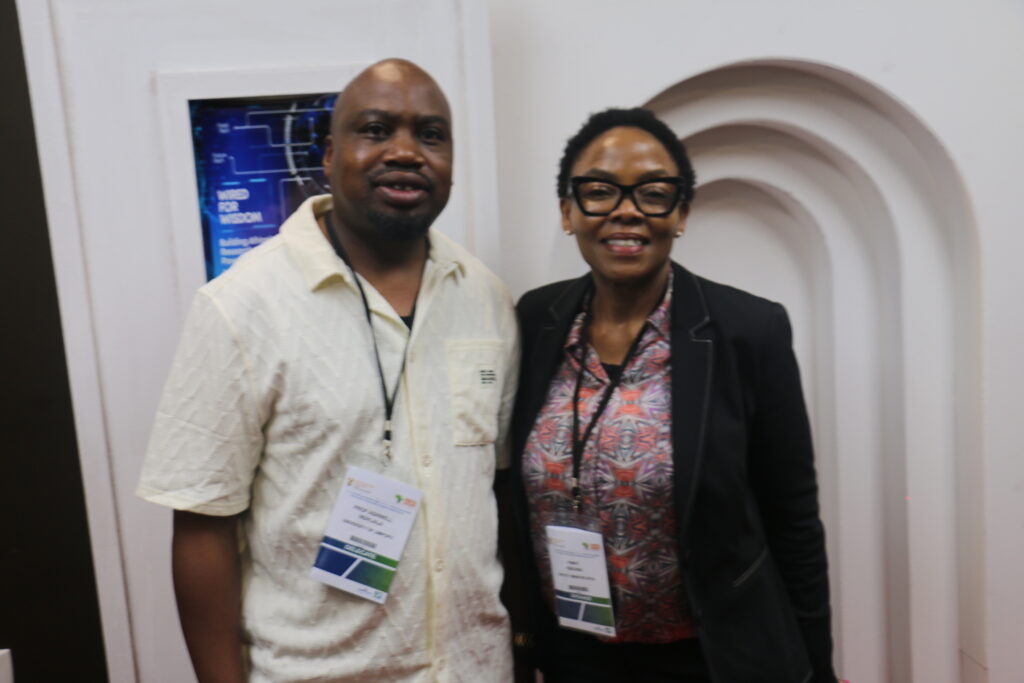
Professor Ashwell Ndhlala, Associate Professor and Bioeconomy Development Specialist at the University of Limpopo (UL), with Deputy Minister of Public Service and Administration, Hon Pinky Kekana, during the Science Forum South Africa held at the CSIR in Pretoria.