


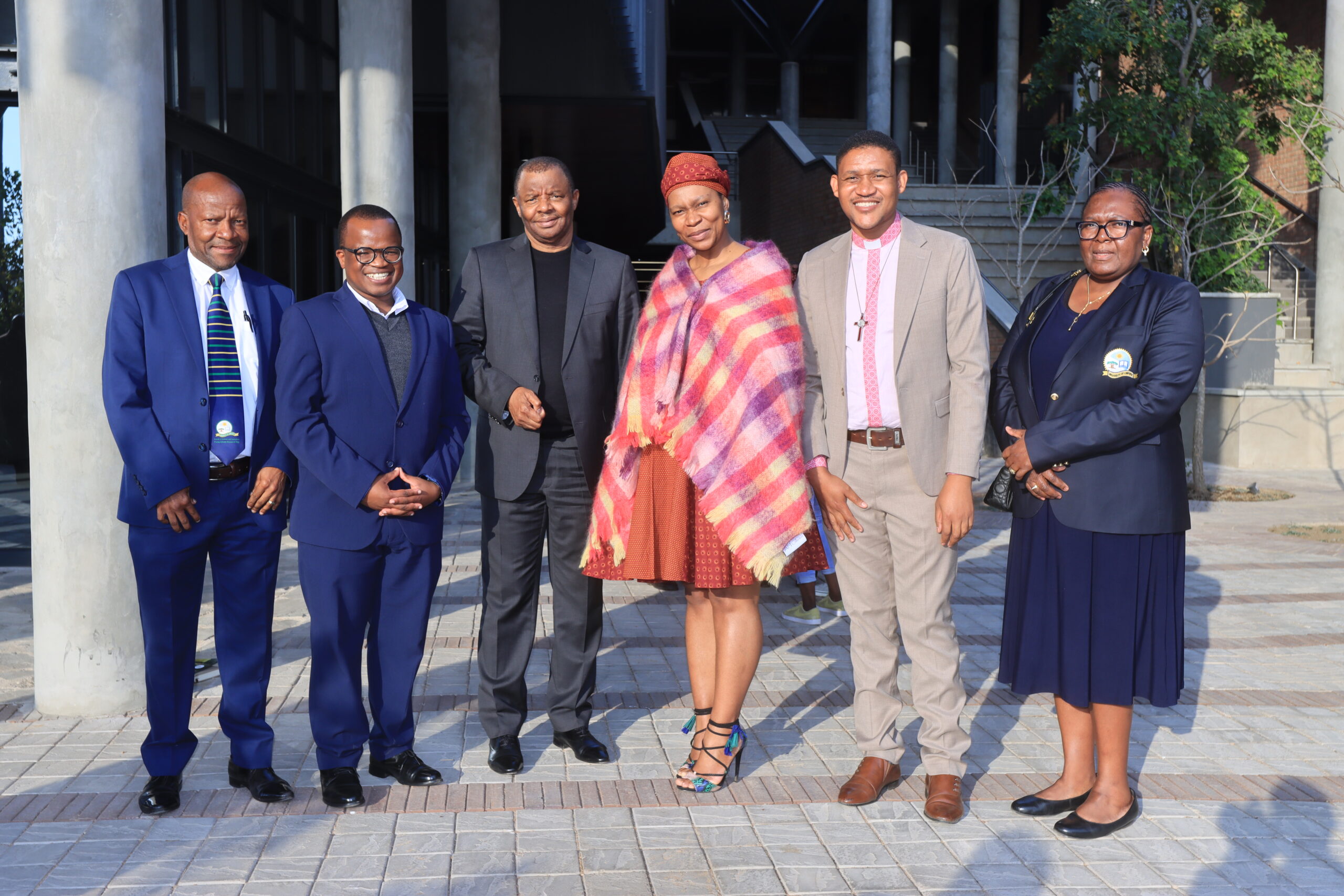
UL’s food security project in Ga-Mothapo equips locals with conservation farming skills, cutting costs, boosting yields, and fostering self-reliance. Photos: Linah Raphela
By Malatji Monyelegwete – malatji.monyelegwete@ul.ac.za
Since 2015, the University of Limpopo (UL), in collaboration with The Archbishop Thabo Makgoba Development Trust (ATMDT), has hosted an annual lecture, aimed at inspiring practical solutions for food security, skills development, and rural livelihoods to eradicate poverty and build sustainable communities
The Thabo Makgoba Annual Lecture, hosted by the University’s Faculty of Science and Agriculture, has become a platform for thought leaders, academics, policymakers, and community members to converge, exchange ideas, share expertise, and explore innovative approaches to address some of South Africa’s most pressing socio-economic challenges.
During the 11th edition of the lecture, Chief Economist of the Agricultural Business Chamber of South Africa (Agbiz), Wandile Sihlobo, emphasised the importance of including the rural communities in South Africa’s economic development agenda.
Under the theme “Skills Development and Rural Livelihoods”, Sihlobo pointed out that most South Africans live in urban areas, rural economies remain crucial, heavily relying on industries such as agriculture, mining, fishing, tourism, and forestry. “With rising unemployment and low economic activity, policymakers are looking for growth and job creation opportunities. Agriculture presents these possibilities, but we must address the infrastructure and governance challenges that have plagued the sector for two decades,” he stated.

Agriculture expert Wandile Sihlobo says that in many rural communities, agriculture and tourism remain among the few viable industries capable of creating jobs and sustaining livelihoods.
Sihlobo, who also lectures at Stellenbosch University and is a Visiting Research Fellow at the Wits School of Governance, acknowledged South Africa’s progress under the Marketing of Agricultural Products Act of 1996 but noted persistent inefficiencies: poor financial management in provincial departments, weak policy implementation, and dysfunctional municipalities. His message was clear, addressing these weaknesses could unlock agriculture’s full potential as a driver of jobs, food security, and dignity.
From its inception, the lecture series has spotlighted agriculture’s role in meeting essential survival needs while opening pathways to self-reliance. One of its most tangible legacies is the food security project in Ga-Mothapo, Polokwane Local Municipality. This initiative has introduced local communities to conservation agriculture, cultivating crops with minimal reliance on costly fertilisers and excessive irrigation, and provided hands-on training in sustainable farming methods.
Faculty members from UL’s Department of Plant Production, Soil Science, and Agricultural Engineering have led this work, equipping community members with practical skills that reduce costs, increase yields, and foster independence. It is a testament to how academic expertise, when applied beyond the classroom, can transform lives.
Prof Leseilane Mampuru, Acting Executive Dean of the Faculty of Science and Agriculture, described the lecture as a cornerstone of the university’s community engagement. “This annual lecture continues to address social challenges around food security and promote sustainable agricultural practices for continued food production,” he said.
Joining virtually, Archbishop Thabo Makgoba, Chairman and Trustee of The Archbishop Thabo Makgoba Development Trust (ATMDT), emphasised the value of partnering with universities to foster ethical leadership, local economic development, and rural empowerment. “Lectures like this one are important platforms for sharing knowledge and facilitating dialogue between experts, community members, and other stakeholders,” he noted.

UL Vice-Chancellor Prof Mahlo Mokgalong highlights agriculture’s role in sustaining global livelihoods and driving meaningful change.
UL Vice-Chancellor and Principal, Prof Mahlo Mokgalong, underlined agriculture’s global importance, noting that 40% of livelihoods worldwide, and 60% in sub-Saharan Africa, depend on the sector. “These lectures challenge us to reflect on how agriculture can be harnessed to bring about meaningful change,” he said.
The event also featured three female UL alumnae agri-entrepreneurs who showcased their innovative work, proving that education, innovation, and local action can grow both crops and communities. This first-ever initiative of the Annual Lecture demonstrated that the UL’s agricultural programmes, offered in the School of Agriculture and Environmental Sciences, are responsive to the country’s pressing “three Ps” socio-economic challenges: Poverty, Inequality, and Unemployment.