


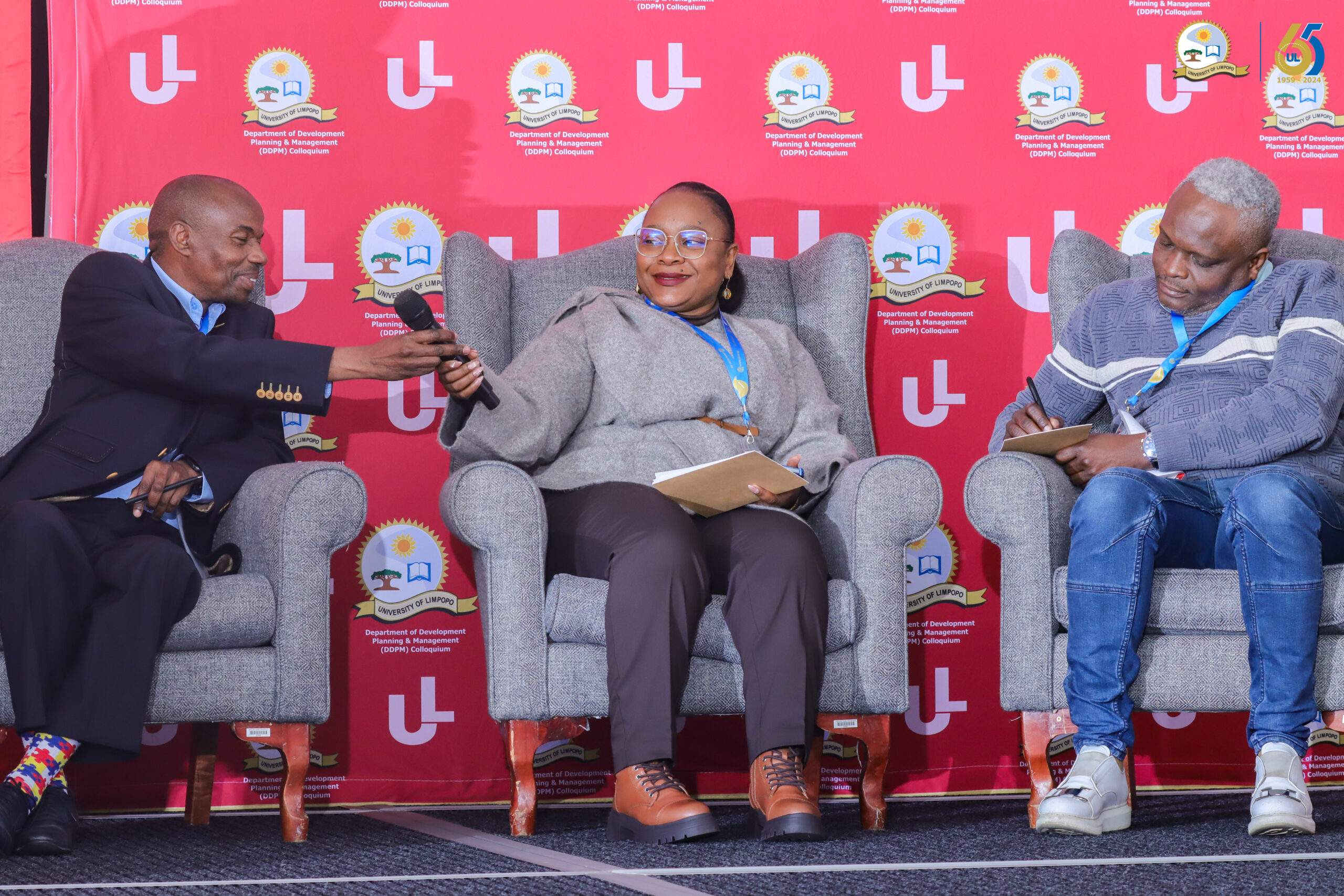
Panellists discuss integrating spatial planning, rural development and climate disaster risk response.
Colloquium argues that better spatial planning is key to reducing disaster risk and building resilient communities across Sub-Saharan Africa
By Phishego Mohubedu -ulpublications@ul.ac.za
Academics, government officials and development practitioners gathered at the University of Limpopo’s (UL) Second Annual Colloquium to examine how spatial planning can help address the challenges facing Sub-Saharan Africa
Hosted by the Department of Development Planning and Management in the School of Economics and Management, and sponsored by Santam, the event focused on the links between spatial planning, socio-economic development and climate disaster risk management.
Held under the theme, “The Nexus Between Spatial Planning, Socio-Economic Development and Climate Disaster Risk Response in the Sub-Saharan Region”, the colloquium drew academics, researchers, municipal officials, development practitioners and policymakers to share research, debate policy and discuss practical approaches to strengthening disaster resilience and improving community planning.
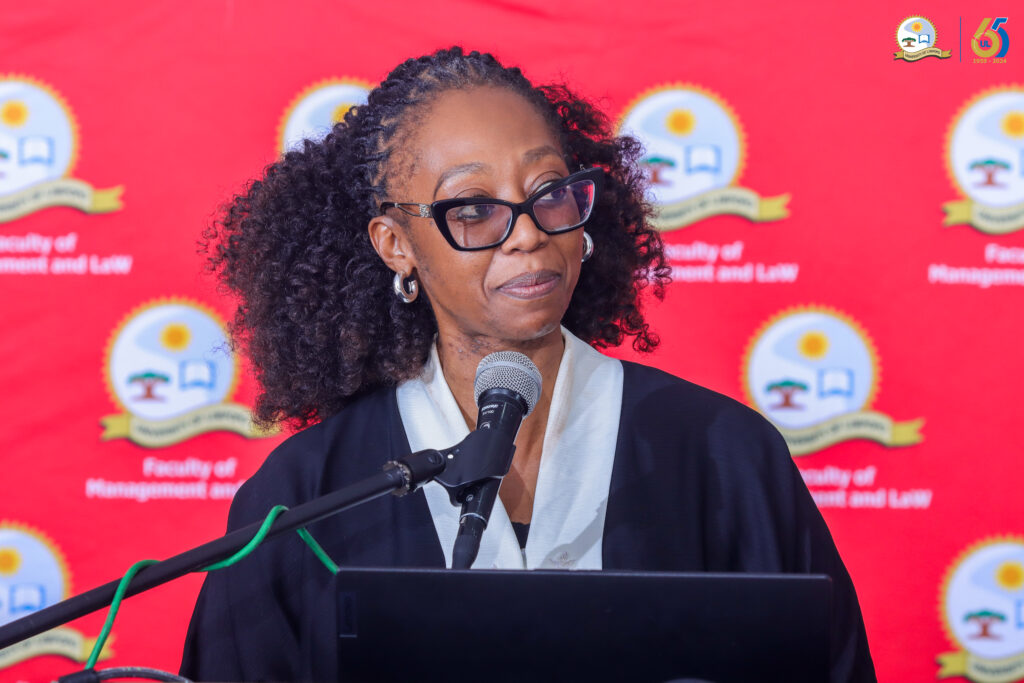
Lebogang Mosotho, Disaster Management Officer at Capricorn District Municipality and President of the Disaster Management Institute of Southern Africa, delivers the keynote address.
Delivering the keynote address, Lebogang Mosotho, Disaster Management Officer at Capricorn District Municipality, highlighted that the negative impact of climate change is often exacerbated by inadequate planning rather than natural hazards alone.
She warned that settlements established in floodplains, wetlands and other high-risk areas continue to expose communities to avoidable disasters.
“Spatial planning is far more than land-use management; it is a strategic development tool. Where planning fails, vulnerability increases, but where planning succeeds, developmental gains are protected,” she stated.
Mosotho called for a deliberate integration of planning, disaster risk management and governance by decision-makers to address rapid urbanisation, informal settlements and escalating climate-related threats.

Executive Dean of the Faculty of Management and Law at UL, Professor Omphemetse Sibanda, congratulates the Department of Development Planning and Management on hosting the second Annual Colloquium.
Executive Dean of the Faculty of Management and Law at UL, Professor Omphemetse Sibanda, said the colloquium created an opportunity for scholars and practitioners to examine development challenges confronting South Africa and the broader Sub-Saharan region.
He said, “sustainable development depends on recognising the relationship between spatial planning, economic growth, environmental protection and disaster risk reduction.”
Head of the Department of Development Planning and Management, Professor Ngoako Mokoele, said the discussions were intended to move beyond theory towards producing practical solutions to the country’s development challenges.
He noted that many communities continue to experience the consequences of historical planning patterns, with settlements located in areas vulnerable to floods and other disasters.
“Disasters are not solely natural occurrences; they are often influenced by human actions and planning decisions. We hope this colloquium will generate evidence-based policy recommendations and quality research that can inform future planning,” he remarked.
Dr Moses Khangale, Manager of Stakeholder Programmes at Santam, delivered a presentation titled “Building Resilience Through Partnership”. He encouraged students to adopt a global perspective on disaster risk reduction by drawing lessons from the Sendai Framework.
He stated that ageing infrastructure, poor maintenance and weak project implementation continue to contribute to growing losses in the insurance sector. To address these challenges, he argued, requires partnerships between government, academia and the private sector to strengthen infrastructure, improve spatial planning and reduce disaster risks.
For students, the colloquium offered a vital opportunity to link classroom learning with real-world development challenges.
Martin Boshomane, an Honours student in Development Planning and Management at UL, said the discussions reinforced the importance of spatial planning in shaping sustainable communities.
“Development takes place on land, making spatial planning fundamental to sustainable development. I also learned that poor coordination between different levels of government often excludes rural communities from development processes. This colloquium created an important opportunity for dialogue that can contribute to more resilient communities.”
The programme also featured research presentations from emerging scholars, including Bashio Mogotle, a final-year Law student at the University of South Africa (UNISA). Mogotle presented a paper titled “Towards Safeguarding the Environment as a Constitutional Mandate: A Critical Analysis of Practical Environmental Governance in South Africa”.
In the paper, he argued that protecting the environment should be viewed not only as good policy but as a constitutional responsibility.
“Environmental resilience is not only a policy issue but also a constitutional mandate. Strengthening environmental governance is essential to protecting communities and ensuring sustainable development for future generations.
“Where planning fails, vulnerability increases, but where planning succeeds, developmental gains are protected.”