


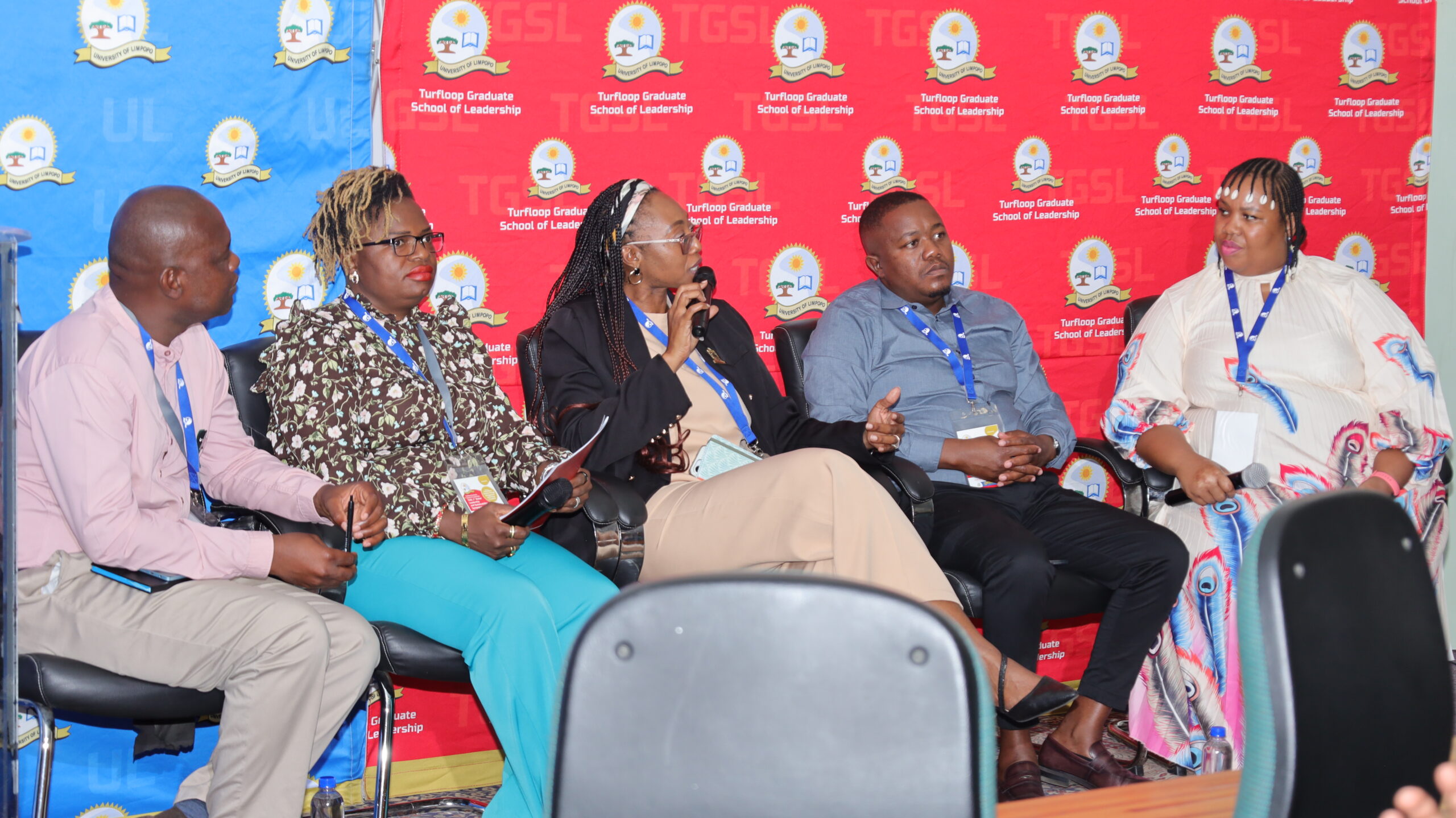
Panel discussion featuring experts from diverse fields exploring strategies to drive Africa’s response to climate change and promote a sustainable future. Photos: Evidence Mongwe & Linah
By Nyeleti Mabasa and Isaack Duba -ulpublications@ul.ac.za
Amid growing calls for climate accountability and sustainable leadership, the Turfloop Graduate School of Leadership (TGSL) at the University of Limpopo (UL) transformed insight into action through the 1st Global Leadership and Sustainability Symposium
The event sparked bold conversations on how knowledge, technology, and policy can work together to build a greener and fairer future. Held under the theme “Innovation, Climate Change Management and Energy Transition”, the symposium brought together academics, industry leaders, and policymakers to explore practical solutions to the climate crisis.
Professor Sipho Mokoena, Director of TGSL, called for stronger partnerships and collective action.
“Universities must move beyond research in isolation and partner with communities, industry, and government to turn evidence into impact,” he said. “If institutions of learning do not lead this change, we risk leaving the next generation with the consequences of our inaction.”
Reflecting on Africa’s position in the global energy transition, Dr Kolisa Sinyanya Founder of Ulwazi Scientific Communications and STEM Research, Award Winning Ocean Biogeochemist), noted that the continent’s future depends as much on water security as it does on clean energy.
“Innovation often starts by rethinking what we already have,” she said, urging participants to harness Africa’s ecosystems and storytelling traditions to bridge the gap between policy, academia, and communities. “The real gap is not ideas but integration.”
Dr Sinyanya further called for an inclusive energy transition that creates jobs, empowers women and youth, and values indigenous knowledge systems as vital to sustainable development.
The symposium showcased innovative projects from across Africa and beyond. Michael Acheampong, a master’s student in Food and Post-Harvest Loss Technologies, presented energy-efficient stove designs for Ghanaian schools and households.
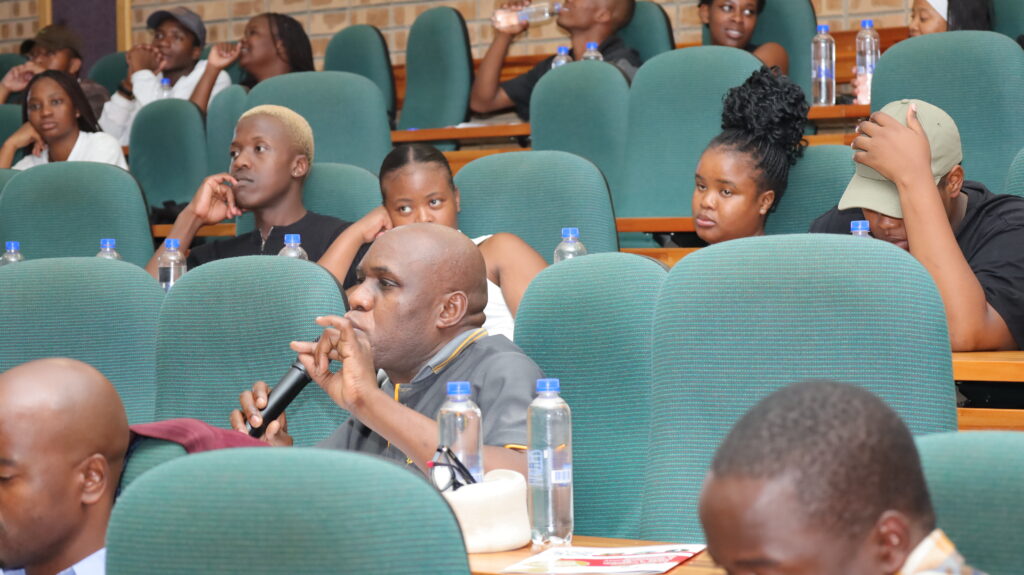
Delegates exchange ideas during the symposium, emphasising collaboration between academia, government, and industry to drive inclusive, evidence-based innovation.
“These stoves reduce emissions, cut fuel use, and are made from materials that communities can easily access and maintain,” he explained. The initiative aims to reduce deforestation and improve safety in local kitchens through participatory design.
Dr Jiwnath Ghimire, Assistant Professor at Iowa State University, shared research on renewable energy transition pathways for rural towns in the United States.
“By engaging local communities and planning collaboratively, we can map energy pathways that are both technically sound and socially inclusive,” he said.
His study explored alternative energy models, including solar, biogas, and efficiency-based systems, which could inform sustainable transitions across Africa.
Professor Omphemetse Sibanda, Executive Dean of the Faculty of Management and Law at UL, emphasised that the global energy transition is inevitable and that action must replace observation.
“You are not mere observers; you are advocates in the story of our planet’s future. Innovation is more than novelty — it is the essence of adaptation and resilience,” he said.
Prof Sibanda called for bold thinking to reimagine infrastructure, governance, and economies in response to environmental pressures.
“Energy grids around the world are collapsing under demand. A complete transformation in how we generate and use energy is indispensable if we are to limit catastrophic warming,” he cautioned, adding that universities must be at the forefront of this transformation through research, education, and policy engagement.