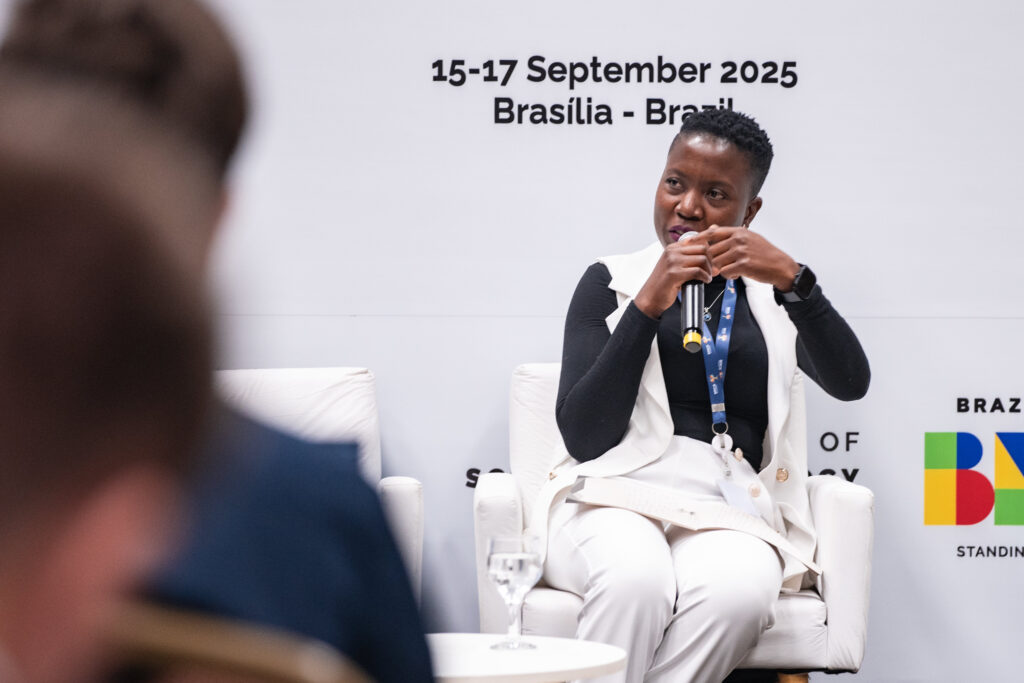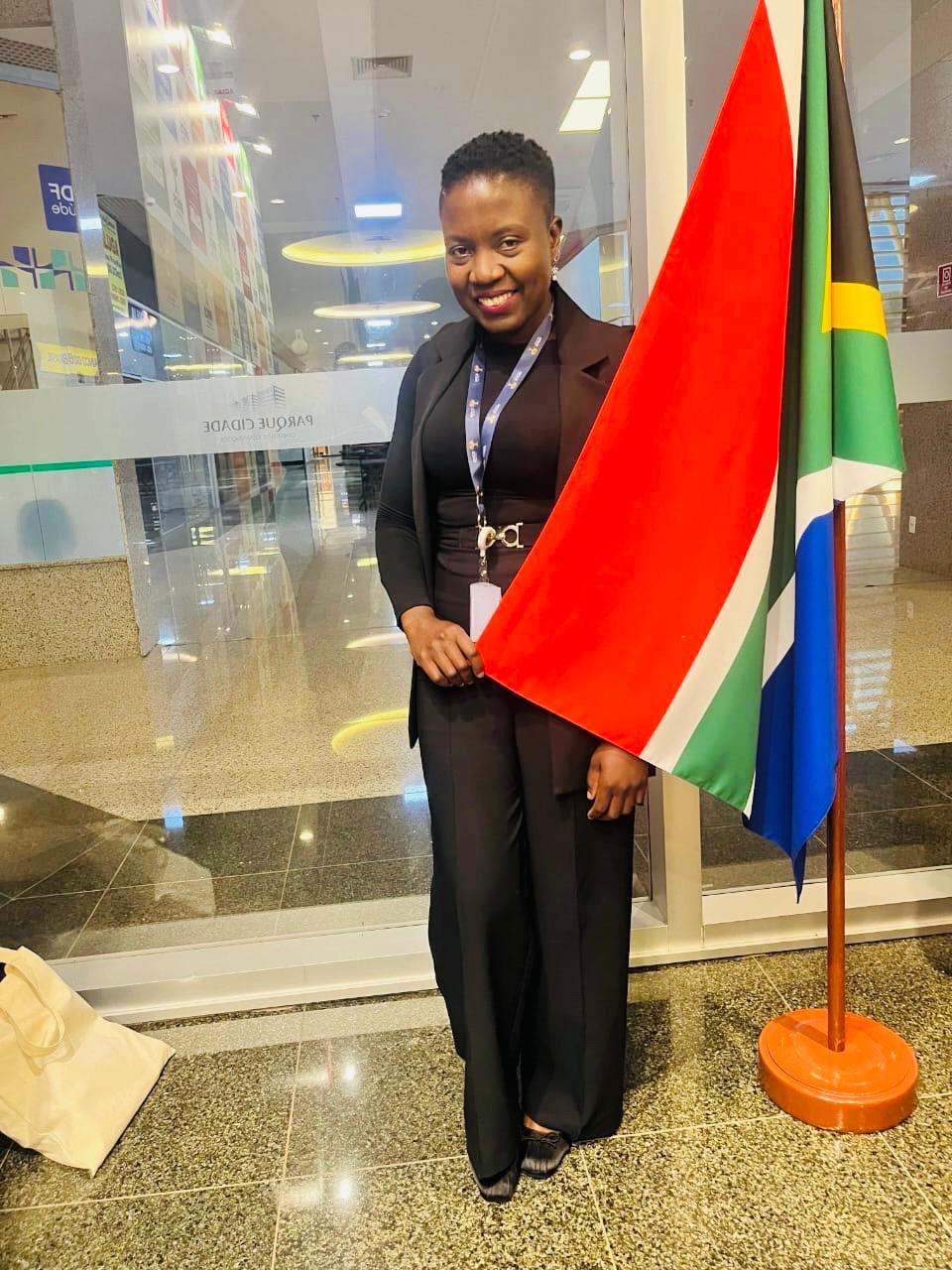
Dr Beauty Shibiri from the Materials Modelling Centre represents South Africa and the University of Limpopo on the global stage, contributing to solutions for critical scientific and societal challenges through collaboration among BRICS nations.
By Malatji Monyelegwete – malatji.monyelegwete@ul.ac.za
Dr Beauty Shibiri, a Postdoctoral Research Fellow in the Faculty of Science and Agriculture at the University of Limpopo (UL), represented South Africa at the 10th BRICS Young Scientists’ Forum (YSF) in Brasilia, Brazil. This prestigious global platform focuses on addressing critical scientific and societal challenges through collaboration among BRICS nations
Based at UL’s Materials Modelling Centre, Dr Shibiri is advancing research at the intersection of technology and sustainability. Her work employs computational simulations integrated with artificial intelligence to develop innovative solutions for energy and storage challenges, particularly in the field of lithium-ion battery cathodes, which are essential for sustainable and efficient energy systems.
Chosen as one of only nine South African delegates from a competitive pool of 256 applicants across more than 46 institutions, Dr Shibiri was selected through a rigorous process led by the Department of Science, Technology and Innovation (DSTI) and the Academy of Science of South Africa (ASSAf).
The 2025 BRICS YSF focused on three key themes:
- Research on Climate Change Mitigation and Adaptation, contributing to theCOP30 climate agenda;
- Science Diplomacy in a Changing World, emphasising perspectives from theGlobal South; and
- Artificial Intelligence for Societal Solutions, exploring how emerging technologies can enhance lives across BRICS nations.
Reflecting on her experience at BRICS 2025 YSF, Dr Shibiri remarked: “It is an incredible honour to be part of the BRICS 2025 Young Scientists’ Forum cohort. Representing South Africa among such exceptional minds is a privilege that reaffirms the relevance of my work in addressing real-world challenges. This opportunity will enable me to build long-term collaborations and contribute meaningfully to solutions that matter.”
Her selection underscores the global impact of UL’s research community, particularly in driving sustainable technological innovation.
“Being among the crème de la crème — the best of the best — reminds me of the excellence emerging from our University and the crucial role science plays in solving societal problems,” she added.
Dr Shibiri’s recognition at BRICS follows another significant achievement, being named a Mail & Guardian 200 Young South Africans 2024 winner in the Energy category. Her work exemplifies scientific excellence and reflects UL’s growing contribution to addressing global challenges through African-led innovation.