
Some University of Limpopo academic staff and management during a virtual engagement with Guru Kashi University (GKU) in India. Photos: Malatji Monyelegwete
By Malatji Monyelegwete – malatji.monyelegwete@ul.ac.za
The University of Limpopo (UL) continues to enhance its global presence through strategic partnerships with international institutions that align with its vision for transformative education and research
The latest collaboration is with Guru Kashi University (GKU) in India, focusing on fostering academic cooperation and innovation between the two universities.
After a productive virtual engagement, UL and GKU have begun to explore various collaborative initiatives, including joint funding proposals, virtual teaching, co-supervision of postgraduate students, and joint assessment of PhD theses. The partnership also plans to host a Joint International Conference, offer Joint and Dual Degree Programmes, Faculty Development Programmes (FDPs), and a series of coordinated seminars and webinars. These initiatives are part of efforts to implement the recently signed three-year Memorandum of Understanding (MoU).

Deputy Vice-Chancellor Designate at UL Dr Jeffery Mabelebele.
UL’s Vice-Chancellor and Principal Designate, Dr Jeffery Mabelebele, described the university’s academic landscape, highlighting its organisation into four faculties: Humanities; Science and Agriculture; Management and Law; and Health Sciences. UL currently enrols over 24,000 students, including a growing number of postgraduates.
Dr Mabelebele emphasised that UL’s growth reflects its mission to produce graduates and research outputs that meet Africa’s developmental priorities. “We are excited to partner with GKU because the initiatives we discussed align closely with our strategic priorities. They promote internationalisation, enhance student and staff mobility, and foster meaningful research collaboration between South Africa and the global community,” he stated.
Highlighting UL’s research capacity, Dr Mabelebele noted that the university has several National Research Foundation (NRF)-rated researchers, with over 65 currently recognised. This number is expected to grow as UL’s research output expands. The collaboration with GKU aligns with UL’s Strategic Plan 2026, Strategic Plan 2030, and Research and Innovation Plan.
Dr Mabelebele also expressed enthusiasm for the planned establishment of a Mandela Peace Initiative Institute at GKU, which aims to advance global peace and social justice.
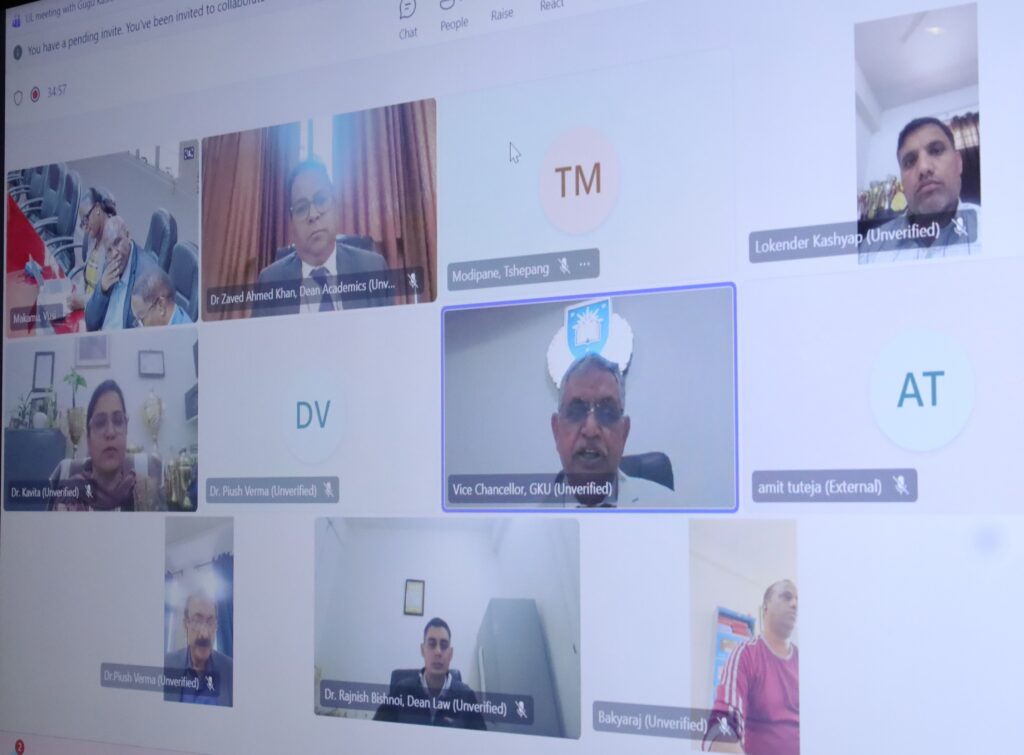
Virtual presentation by delegates of Guru Kashi University, led by Dr Inderjeet Singh, Vice Chancellor of GKU.
Dr Inderjeet Singh, Vice-Chancellor of GKU, identified several promising areas for collaboration, including joint and dual degree programmes, student exchanges, virtual courses, academic conferences, and PhD co-supervision. He also expressed interest in establishing a Mahatma Gandhi Chair Centre at UL to promote intercultural learning and research.

Director for International Affairs at UL Prof Nonceba Mbambo-Kekana
According to Prof Nonceba Mbambo-Kekana, UL’s Director for International Affairs, the meeting aimed to move beyond the signing of the MoU and begin translating commitments into action. “This engagement allowed colleagues from various disciplines to connect, exchange ideas, and establish strategic working relationships,” she explained.
Prof Mbambo-Kekana further emphasised that internationalisation remains a strategic priority for UL, fostering global citizenship, enhancing participation in international knowledge creation, and promoting research that is locally grounded and globally relevant. “While our programmes address the needs of local communities and the African continent, they also generate insights and solutions beneficial to the world,” she stated.
Dr Ahmed Khan, Dean of Academics at GKU, added that the Government of India encourages institutions to prioritise outcome-driven programmes, a philosophy that closely aligns with South Africa’s higher education agenda.